Youtube视频:Anderson localization: randomly placed mangroves offer better tsunami protection
This variant of the video  • More on the importance of mangroves shows a wave interacting with a randomized arrangement of obstacles, as opposed to a regular one. The positions and the obstacles have been randomly shifted, and the radii vary randomly around a constant value. All random variables are distributed uniformly and symmetrically around zero, so that the total area of the circles is about the same as in the regular case (because of the law of large numbers). Colors indicate the energy density of the wave (wave height squared plus the time-derivative of that height squared), where red indicates more energy, while blue indicates less energy. The random configuration of obstacles seems more effective than the regular one, which may be a manifestation of Anderson localization, which says that random media are good at trapping waves:https://en.wikipedia.org/wiki/Anderson_localization
该视频的变体更多地介绍了红树林的重要性,展示了波浪与随机排列的障碍物(而不是常规障碍物)相互作用。位置和障碍物随机移动,半径围绕恒定值随机变化。所有随机变量围绕零均匀且对称地分布,因此圆的总面积与常规情况大致相同(因为大数定律)。颜色表示波的能量密度(波高平方加上该高度平方的时间导数),其中红色表示能量较多,而蓝色表示能量较少。障碍物的随机配置似乎比常规的更有效,这可能是安德森局域化的一种表现,即随机介质擅长捕获波:https://en.wikipedia.org/wiki/Anderson_localization
See also https://images.math.cnrs.fr/Des-ondes… for more explanations (in French) on a few previous simulations of wave equations. The simulation solves the wave equation by discretization. The algorithm is adapted from the paper https://hplgit.github.io/fdm-book/doc… Reflections on the boundaries of the rectangle are minimized by adding Neumann-type boundary conditions on the time-derivative of the wave. C code: https://github.com/nilsberglund-orlea… https://www.idpoisson.fr/berglund/sof…
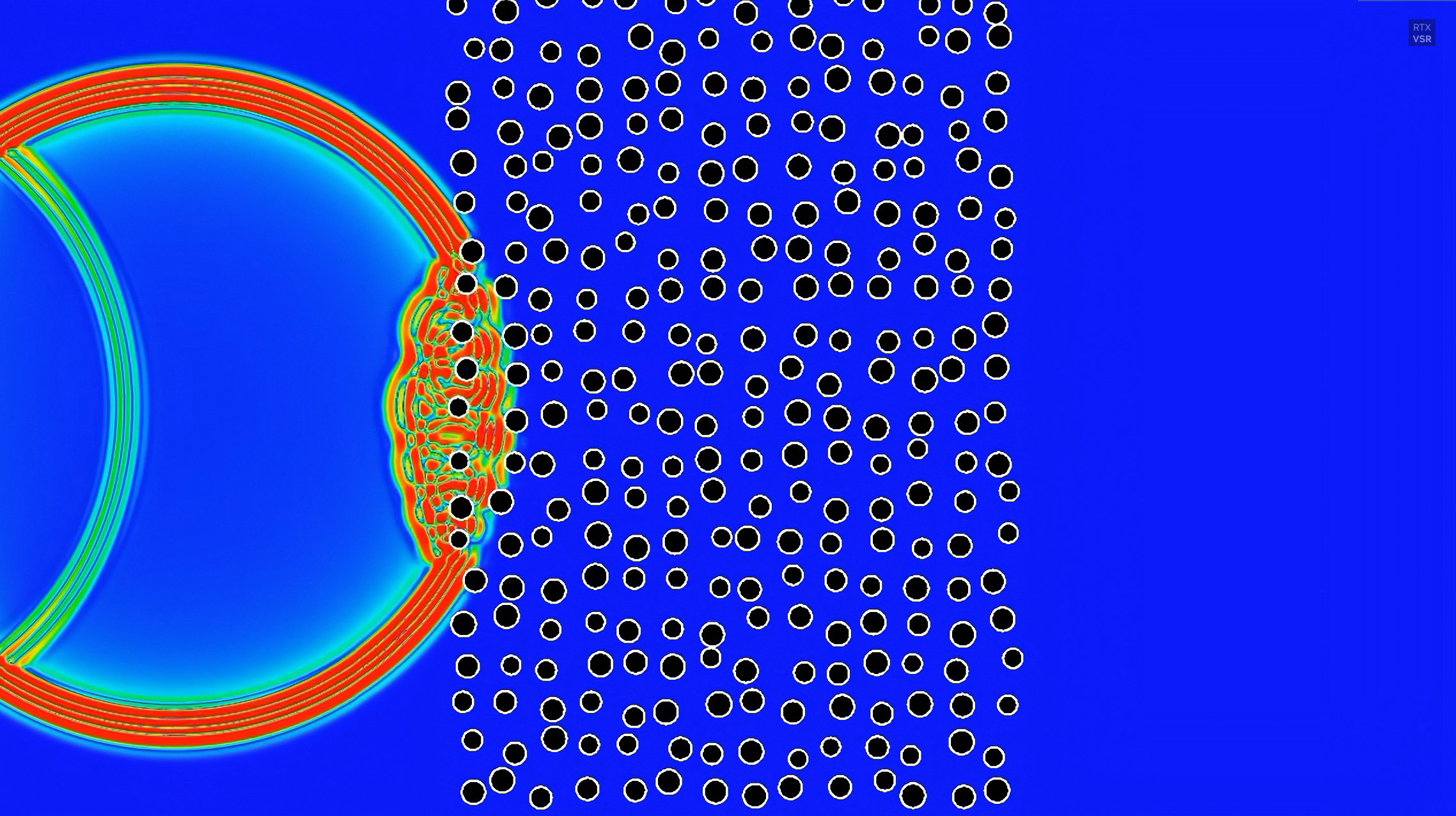
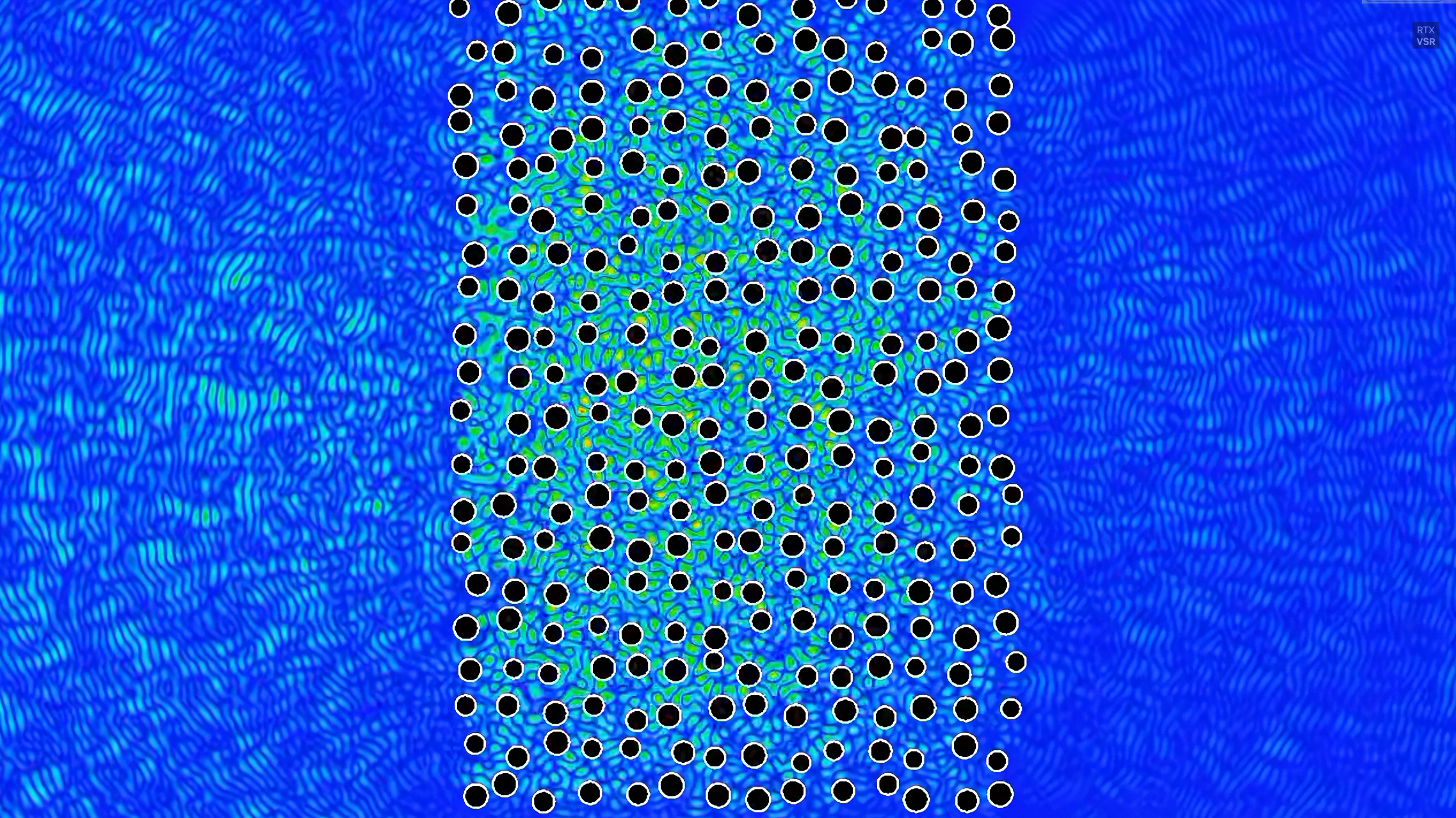
视频展示的是海啸发生时,随机栽种的树木有效阻挡了海啸的侵袭。
所受启发:
假设黑点是原子分子,随着排列的不规则分布,左侧来的波遇到原子之后会受到各种反射等影响,最终形成反射波与入射波的干涉叠加,以及部分波穿过障碍物继续传播。很像光的反射和投射,但又有所不同。比如像隧穿效应。
注意,这只是看起来像,但是否能借此解释隧穿效应?
又是否存在量子世界的Anderson localization效应?